Authors: Igor Sulzbacher Schardong (NC State University), Dominic D. Reisig (NC State University), Berenice Romero (Louisiana State University), Jeff Davis, (Louisiana State University)
This tool is coupled with recent changes that we have made to soybean defoliation thresholds.
Soybean loopers can be tricky pests. One of those reasons is our that our defoliation thresholds (the level of leaf loss when we say it’s time to spray) let the caterpillars grow. Loopers do most of their feeding damage in the last few days before they turn into moths. That’s when they’re biggest and when they are harder to kill with insecticides.
If you wait until loopers hit the threshold, you may also be letting them grow larger and more damaging. That’s why it’s important to 1) keep defoliation under the threshold, 2) watch how many loopers are in the field, 3) check their size, and 4) estimate how much more they might eat.
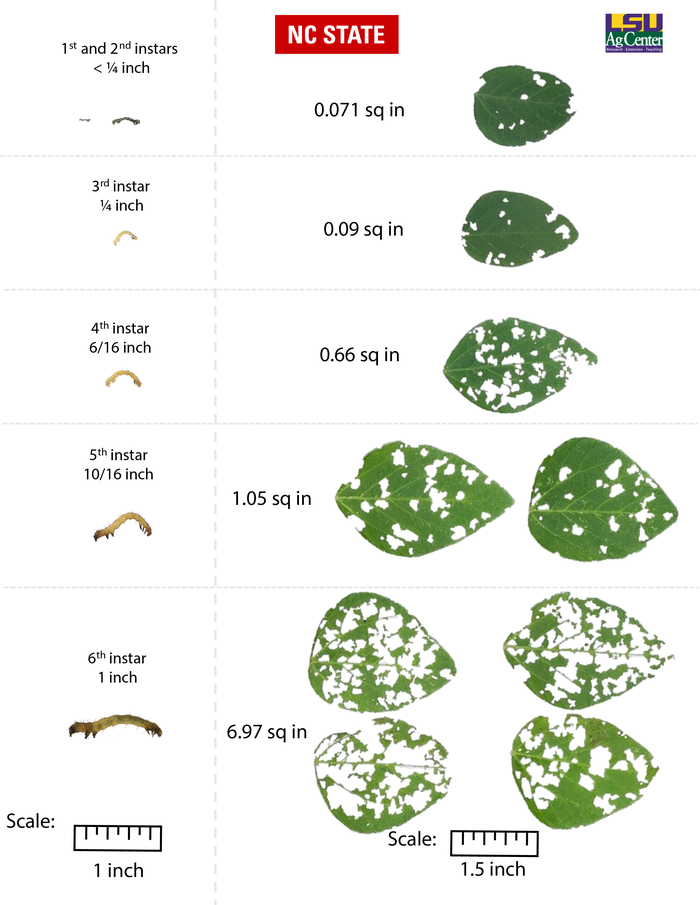
We put together a guide using both published research and our own data. It shows how big soybean loopers are at each stage (called “instars”, with a 1-inch scale to compare). It also shows how much leaf tissue they eat as they grow (with a 1.5-inch leaf scale).
We found that the smallest loopers (1st and 2nd instars) eat very little, less than 1/10 of an inch of a leaf. However, one large 6th instar looper can eat almost 7 inches of leaf tissue.
When you scout, don’t just look at how much damage has already happened. Also look at how many loopers you see and how big they are. A few big loopers can do a lot of damage fast. That can help you make better decisions and avoid surprises.