Maximizing NC Soybean Yield Through Planting Date and Maturity Group
Written by DJ Stokes and Dr. Rachel Vann
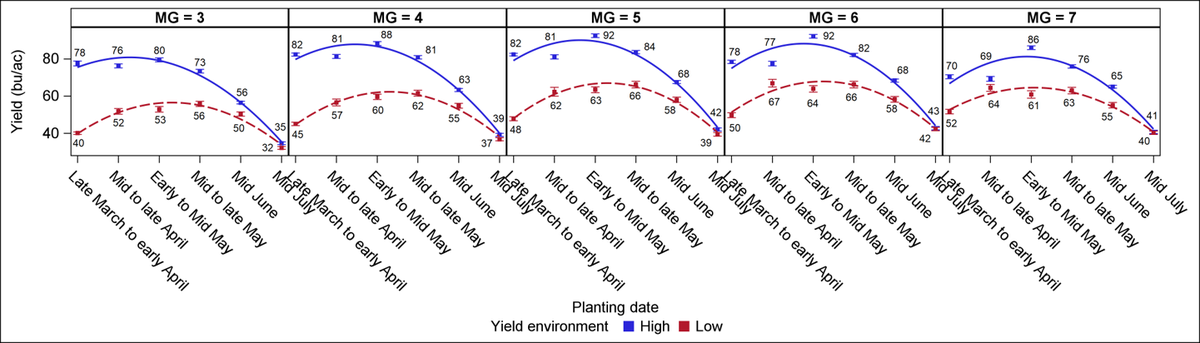
Recent analyses indicate that planting date and maturity group are two of the strongest predictors of high soybean yield in North Carolina. Optimal soybean production practices are dependent on planting date. Small-plot research from 2019-2021 at 12 sites across North Carolina has investigated the impacts of maturity group and seeding rate on yield and seed quality across diverse planting dates.
Research in 2022 across North Carolina:
Locations: Beaufort, Camden, Johnston, and Rowan Counties
Planting Dates: late March, mid-April, mid-May, mid-June, mid-July
Maturity Groups: MG2.6, MG3.6, MG4.5, MG5.6, MG6.6, MG7.2
Seeding Rates: 75,000, 100,000, 125,000, 150,000 and 175,000 seeds/A
More Information
Soil Fertility for Soybeans - Dr. Luke Gatiboni
The applied soil fertility research program is annually looking at the response of soybeans to nutrients, especially phosphorus and potassium, which represents the main costs of fertilizers for soybeans. Currently, we have three long-term trials in Tidewater, Coastal Plain, and Piedmont regions, where we have soils with phosphorus and potassium indexes varying from very low to very high. Every year we grow soybean varieties currently recommended to NC and we recalculate the critical P-Index (P-I) and K-Index (K-I) for soybean. Our results show no response to P and K fertilization in soils with P-I or K-I higher than 50, which is the critical level recommended by NCDA&CS. In the last two years, we repeated these studies in eight high-yielding on-farm sites and the results were the same: no response to P and K in soils with P-I and K-I higher than 50. In another set of trials, we are testing other fertility strategies for high-yielding soybean, including adding in-furrow P, use of elemental sulfur, foliar micronutrients (boron and manganese), and nitrogen. None of these strategies increased yields but we did notice less nodulation when nitrogen was applied to soybean in some sites. As a general conclusion, we recognize that the current recommendations for North Carolina are up to date and adequate for soybean grown in this state.