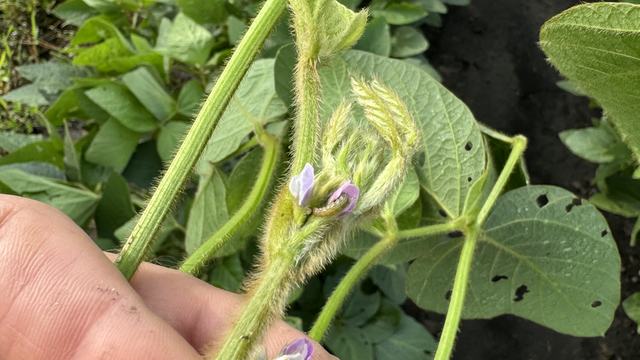
For many years, corn earworm has been the most costly insect pest in North Carolina soybeans. This includes both the cost of control and yield losses.
Corn earworm is usually a later-season pest. It is more common in late-planted soybeans because local populations build up first in corn. Corn acts as a nursery crop. Larvae feed in corn, drop to the soil, pupate, and later emerge as moths. These moths then move into soybeans that are flowering in late July and August.
However, corn earworm moths can also migrate from southern areas. We have found corn earworms in North Carolina soybeans and wheat as early as May. These were almost certainly migrants from the south. This may help explain why some earlier-planted soybeans have had unusually high corn earworm numbers this year.
Many growers are asking whether they should treat corn earworm in soybeans at R1, R2, or R3. These stages are beginning flower, full flower, and beginning pod.
For soybeans at R1 and R2, the answer is probably no.
Soybeans can make far more flowers than they can turn into harvestable pods. Because of this, they can often compensate for corn earworm feeding on flowers. North Carolina research showed that soybeans could tolerate corn earworm levels up to three times the treatment threshold during R1 and R2 without yield loss.
However, stress matters. When soybeans are stressed, they may not be able to recover from flower feeding as well. In that same study, corn earworm feeding at one-half of the threshold caused yield loss under stressed conditions.
Growers should be more protective once pods are present. Pod feeding is more risky than flower feeding. Even then, soybeans still have a strong ability to compensate. They can sometimes make heavier seed even when some pods are lost.
Recent work from two NC State graduate students, supported by the NC Soybean Producers Association, found that both determinate and indeterminate soybean varieties compensated well after corn earworm feeding both in full-season and double-cropped plantings. In some cases, indeterminate varieties had a slight advantage, but both growth habits were able to recover. As with flower feeding, compensation is more likely when soybeans are not stressed.
The main point is this. Stay alert, but do not rush to spray early flowering soybeans unless the situation clearly calls for it.
Corn earworm risk will likely increase later in the season as larvae finish feeding in corn. After they pupate, moths will emerge and lay eggs in flowering soybeans. Growers should check the light trap network to stay aware of moth flights. These flights show when moths are active and laying eggs in crops.
Several effective insecticides are available for corn earworm in soybeans, including Blackhawk, Denim, Intrepid Edge, Steward, and Vertento.
Avoid broad-spectrum insecticides, such as acephate or pyrethroids, unless they are needed for another insect pest. These products can remove beneficial insects and may cause other pests to flare. We have data showing that broad-spectrum insecticides can flare soybean loopers, and spider mites have also been flared in recent years.
Finally, do not use Besiege, Elevest, or Vantacor in soybeans.